LFP vs NMC Batteries: Where Each Chemistry Wins in 2026
LFP vs NMC batteries: discover which technology dominates EV market by 2026. Compare cost, safety, and performance advantages today.
 verified
Lithium iron phosphate and nickel manganese cobalt batteries are not converging on a single winner in 2026. LFP is the stronger fit when cost, cathode material profile, and the less severe response observed in a specific overcharge experiment matter most. NMC remains valuable when a vehicle must store more energy in less mass and volume. The practical answer is not that LFP will replace NMC. It is that automakers can assign each chemistry to the vehicles and duty cycles where its documented tradeoffs are easiest to manage.
How this comparison was built
This is a desk-based, specs-and-published-evidence comparison, not a hands-on battery test. We reviewed market data from the International Energy Agency, a cost-model manual from Argonne National Laboratory, an original overcharge study indexed by the US Department of Energy, battery-lifespan guidance from the National Laboratory of the Rockies, manufacturer guidance from Ford, product-development statements from CATL and Tesla, and the European Union’s life-cycle carbon-footprint rules. Product claims are identified as manufacturer claims. Laboratory findings are kept within the tested conditions, and model inputs are not presented as current transaction prices.
LFP and NMC in one table
| Decision factor | LFP | NMC | What the evidence supports |
|---|---|---|---|
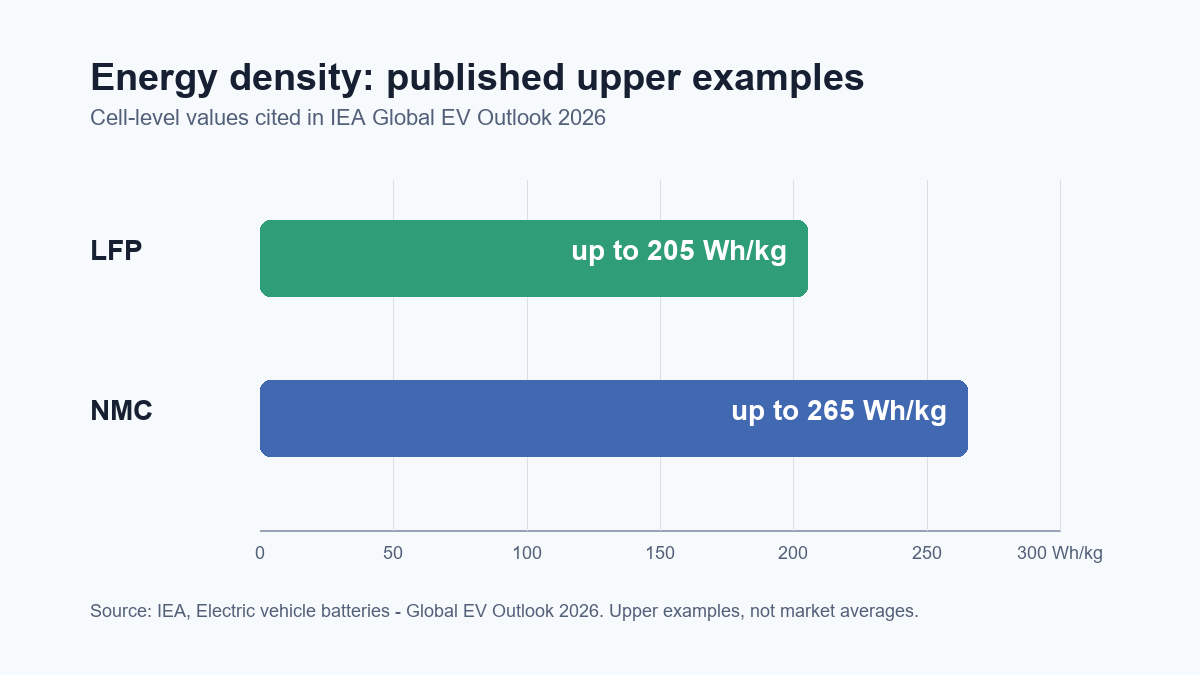
| Energy density | Lower in the current upper examples | Higher in the current upper examples | The IEA cites up to 205 Wh/kg for recent LFP cells and up to 265 Wh/kg for NMC cells. These are upper examples, not market averages.[1] |
| Pack price | Lower average in the IEA’s combined EV and storage comparison | Higher average in that comparison | In 2025, LFP packs were more than 40% cheaper per kWh on average than NMC alternatives, with an important stationary-storage mix caveat.[1] |
| Cathode materials | Iron and phosphate, with no cobalt in the cathode | Nickel, manganese, and cobalt in varying ratios | The IEA and Tesla both distinguish cobalt-free LFP cathodes from nickel-based NMC cathodes that contain cobalt.[1][8] |
| Abuse response | Milder thermal-runaway outcome in one controlled overcharge comparison | More severe outcome in that experiment, especially as nickel share rose | This is one overcharge test across selected commercial cells, not a universal vehicle fire ranking.[3] |
| Best fit | Cost-sensitive standard-range vehicles and stationary storage | Long-range, performance, and packaging-constrained vehicles | Current market and manufacturer choices show a portfolio strategy rather than one chemistry replacing the other.[6][8] |
Where LFP wins
Cost and material exposure
LFP’s clearest advantage is economic. The IEA reports that LFP packs were more than 40% cheaper on average per kWh than NMC alternatives in 2025. That figure needs context: the comparison combines electric vehicles and battery storage, and storage systems can accept lower energy density. It is still strong evidence that LFP can reduce pack cost when space and weight are not the overriding constraints.[1]
Argonne’s BatPaC model illustrates part of the material-cost difference without pretending to show a current market quote. Its July 2022 default inputs list LFP positive-electrode material at $10 per kilogram, while the modeled NMC variants range from $24 to $26 per kilogram. Those figures are dated model inputs, not today’s full-cell or pack prices. Their value is explanatory: nickel and cobalt can make the positive electrode more exposed to expensive raw materials and processing choices.[2]
LFP also removes cobalt from the cathode. That does not make the entire battery supply chain simple or impact-free, because lithium, graphite, energy use, pack electronics, and manufacturing location still matter. It does reduce exposure to one material that remains present in nickel-based NMC and NCA cathodes.[1]
Market scale and suitable use cases
LFP is no longer a niche chemistry. It accounted for more than 55% of global EV battery capacity deployed in 2025, up from nearly 50% in 2024, according to the IEA. Deployment is concentrated in China and emerging markets, so this is a global capacity share rather than proof that every regional market has made the same choice.[1]
Its commercial role is easy to see in real product strategy. Ford identifies LFP in standard-range Mustang Mach-E versions and NCM in extended-range versions. Tesla says it is increasing cobalt-free iron-based batteries particularly in energy-storage and standard-range products, while continuing to use nickel-based cathodes. These are company-specific decisions, but they illustrate the broader split: LFP works well when acceptable range can be delivered without maximizing energy per kilogram.[5][8]
Where NMC wins
More energy in a constrained package
NMC’s main advantage is energy density. The IEA’s current upper examples are 265 Wh/kg for NMC and 205 Wh/kg for LFP. A cell-level number does not translate directly into vehicle range because pack structure, usable state-of-charge window, thermal hardware, aerodynamics, mass, tires, and software all intervene. Even so, the gap explains why NMC remains attractive for long-range vehicles and performance models where every kilogram and liter must carry more energy.[1]
CATL’s own 2026 product presentation makes the same portfolio argument. The company says LFP is approaching its theoretical energy-density limit while NCM remains the high-density path, and it explicitly argues for coordinated development across multiple chemistries. This is a manufacturer’s assessment, not an independent laboratory verdict, but it is useful evidence against the claim that the industry expects one chemistry to eliminate the other.[6]
Range is not the only performance metric
NMC can create room for more range, payload, cabin space, or performance within the same packaging envelope. That advantage becomes less decisive when a standard-range vehicle already meets the buyer’s travel requirement or when stationary storage can accommodate a larger pack. It becomes more decisive in a premium long-distance vehicle, towing application, or any platform whose pack volume is already fixed.
This is why a buyer should compare complete vehicles, not cathode acronyms alone. Published usable capacity, certified range, charging curve, efficiency, thermal management, warranty, and repair policy tell you more about the ownership experience than chemistry by itself.
Safety and lifespan require narrower claims
LFP is often described as simply safer, but the evidence is more specific. In an original study of selected commercial LFP, NCM111, NCM622, and NCM811 cells under the same overcharge condition, the LFP cell entered thermal runaway earlier, yet its response was milder: it emitted smoke without fire, while the tested NCM cells caught fire or exploded. The researchers also found that thermal stability worsened as nickel content increased among the tested NCM cells.[3]
That result supports a limited conclusion about the severity of one abuse mode. It does not prove that every LFP pack is safer than every NMC pack. Cell format, pack spacing, cooling, charge controls, crash protection, manufacturing defects, state of charge, and detection systems can change real-world outcomes. For the wider context, see NexusVolt’s guide to EV battery safety standards and testing.
Lifespan deserves the same discipline. NLR’s battery-lifespan work treats environment, cycling, thermal conditions, operating windows, and charge and discharge rates as interacting variables. Chemistry influences degradation, but a chemistry label cannot provide a trustworthy cycle-life promise for an unspecified cell or vehicle.[4] Our related analysis explains how fast charging affects long-term EV battery health.
Charging guidance depends on the vehicle
Ford’s current guidance shows why owners should follow the manual for their exact pack. For supported Ford LFP vehicles, it recommends a 100% maximum charge and reaching 100% at least once per month to maintain range-estimation accuracy. For NCM vehicles, it recommends 90% for daily home charging and 100% when full range is needed. Ford also says stopping at 80% during DC fast charging can reduce charging time and capacity degradation for both chemistries.[5]
Those values are Ford instructions, not universal chemistry rules. Battery-management calibration and reserve buffers differ by brand and model. Owners should use the automaker’s current documentation instead of copying another vehicle’s charging targets. Readers interested in LFP charging development can also see our report on how LFP chemistry is advancing toward faster charging.
How to choose between LFP and NMC
- Choose the LFP-equipped option when the vehicle already meets your real range requirement and lower purchase cost or a cobalt-free cathode matters more than maximum range.
- Choose the NMC-equipped option when long-distance use, towing, performance, or limited pack space makes energy density worth the additional cost and material complexity.
- Compare the complete specifications, including usable battery capacity, certified efficiency, cold-weather behavior, charging curve, warranty, and payload. Chemistry alone cannot rank two vehicles.
- Use model-specific charging instructions. Even vehicles with the same broad chemistry can have different buffers, thermal systems, and recommended state-of-charge limits.
- Treat sustainability claims as product-specific. The EU Batteries Regulation says carbon-footprint calculations should use the bill of materials and the energy and auxiliary materials at the specific manufacturing plant. A chemistry name is not a complete life-cycle assessment.[7]
For more detail on the manufacturing side, NexusVolt’s overview of sustainable practices in EV battery manufacturing covers the processes around the cell chemistry.
Limitations of this comparison
The market data mix regions and applications. The energy-density figures are upper examples cited by the IEA, not an apples-to-apples test of two cells from the same manufacturer. Argonne’s material costs are public model defaults released in 2022, not current purchase contracts. The safety study tested specific commercial cells under overcharge and should not be generalized to all pack designs or crash scenarios. Ford, CATL, and Tesla describe their own products and strategies. None of those manufacturer statements replaces independent testing of a particular vehicle.
Specifications also move faster than a chemistry label. Cell-to-pack design, silicon content, electrode loading, thermal systems, software, and production quality can narrow or widen the practical gap. A future revision should update the comparison when independent cell-level data are available on matched, current-generation products.
The 2026 conclusion
LFP is winning more of the market because it can provide adequate EV range at lower cost, without cobalt in the cathode, and with a less severe outcome in the cited overcharge experiment. NMC still wins when manufacturers need more energy in a lighter or smaller package. The evidence supports coexistence: LFP for many standard-range and storage uses, and NMC for range, performance, and packaging-constrained applications.
Sources, corrections, and transparency
This article links each quantitative or test-specific statement to an official or primary source. Manufacturer statements are labeled and are not presented as independent validation. If a cited specification changes or a source is corrected, we will update the affected sentence and record the revision date in accordance with our Editorial Policy. Readers can report a suspected error through the site’s published contact channel.

Luis Roche is the editorial byline used for NexusVolt coverage of electric vehicles, battery technology, charging infrastructure, clean energy, and related mobility. Articles under this byline identify their sources where available. Correction requests can be sent to [email protected].
More to Explore
Discover more content from our partner network.



Join the Conversation
0 CommentsLeave a Reply